
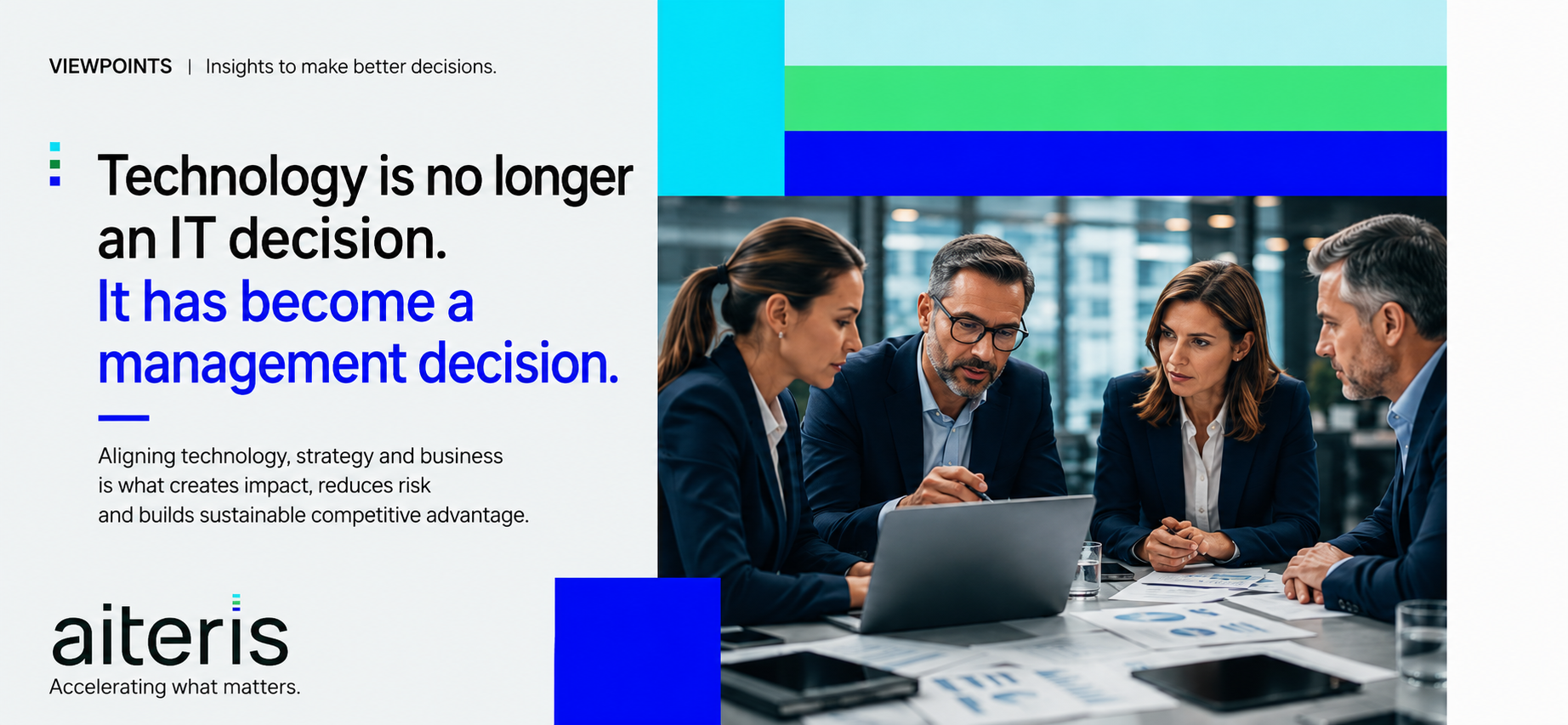
For many years, technology was viewed primarily as a support function.
Information Systems teams were responsible for ensuring the operation of the applications, infrastructure and equipment used by the organisation. Technology was important, but it remained largely confined to the IT domain.
That time is over.
Today, virtually every relevant organisational decision has a technology component. Entering a new market depends on the ability to scale systems and operations. Efficiency requires integrated processes, high-quality data and automation. Regulatory compliance requires control, evidence and traceability. Cybersecurity has become a corporate risk. And Artificial Intelligence is transforming the way organisations work, make decisions and create value.
Technology has moved from the server room to the Boardroom.
Technology decisions, strategic consequences
A cloud decision can influence costs, flexibility, security, sovereignty and the speed of innovation for many years.
The selection of a new platform can change processes, capabilities, operating models and supplier dependencies.
The adoption of Artificial Intelligence can generate significant efficiency gains, but it can also introduce risks related to data, transparency, accountability and human oversight.
A sourcing decision can increase execution capacity or create a dependency that is difficult to reverse.
In all these cases, the decision appears to be technological. But its consequences are strategic.
Therefore, the question can no longer be:
Which technology should we choose?
We need to ask:
What business capability do we want to create, what risks are we prepared to accept, and which technology best supports that decision?
More options do not make the decision easier
There have never been so many technology solutions available.
Public, private or hybrid cloud. Standard software or custom development. Integrated platforms or composable architectures. Proprietary or open-source Artificial Intelligence. Automation, low-code, process mining, AI agents, ERP, CRM and countless specialised solutions.
The range of options has expanded, suppliers have multiplied, and technology cycles have shortened.
Paradoxically, having more options has not made the decision simpler. It has made it more demanding.
Leaders need to assess simultaneously:
- business impact;
- integration with the existing ecosystem;
- total cost over the lifecycle;
- risks and dependencies;
- compliance and security;
- internal capacity to adopt and govern;
- speed of execution and value creation.
A solution may appear more economical in the first year and become more expensive over time. It may accelerate implementation and constrain future evolution. It may include hundreds of features and fail to create any genuinely differentiating capability.
The problem is no longer finding technology.
It defines sufficiently clear criteria for choosing among apparently valid alternatives.
A shared responsibility
This change does not reduce the importance of IT teams. On the contrary, it makes their role more strategic.
But critical technology decisions can no longer remain exclusively within the Information Systems function.
The CIO needs to understand business strategy and priorities. The CEO must understand how technology shapes execution. The CFO needs to assess return, predictability and total cost. The CISO must translate technology risk into corporate risk. Operations must ensure that technology solves real problems rather than merely digitising inefficient processes.
The Board of Directors must therefore understand that many technology decisions are decisions about competitiveness, resilience, investment and the future.
This requires a common language between business and technology: a language that translates architecture into capability, technical risk into business impact, roadmaps into investment decisions and governance into accountability.
Better decisions require more than information
Organisations rarely lack information.
They have reports, dashboards, business cases, commercial proposals, studies and supplier demonstrations.
The challenge is to transform that information into a clear, well-founded and executable decision.
That means answering specific questions:
- What problem are we really trying to solve?
- What business outcome do we want to achieve?
- What are the main trade-offs?
- Which risks are acceptable?
- What dependencies are we creating?
- How will value be measured?
- Who is accountable for the decision and its execution?
- What should move forward now, and what should be deliberately postponed?
Accelerating a decision does not mean reducing rigour. It means structuring the analysis, making the criteria explicit and focusing effort on what truly differentiates the organisation.
The advantage lies in the quality of decisions
Two organisations can acquire the same platform, hire the same supplier or use the same Artificial Intelligence model and achieve completely different results.
The difference rarely lies in technology alone.
It lies in the quality of the decision that preceded the choice, the clarity of priorities, governance, adoption by people and the ability to measure results.
Technology can accelerate a good strategy. But it can also accelerate inefficiencies and make poorly founded decisions harder to correct.
At aiteris, we believe technology is definitively no longer just an IT decision.
It is now a management decision.
We help organisations transform technology complexity into structured, independent and impact-oriented decisions.
Because technology, by itself, does not create a competitive advantage.

